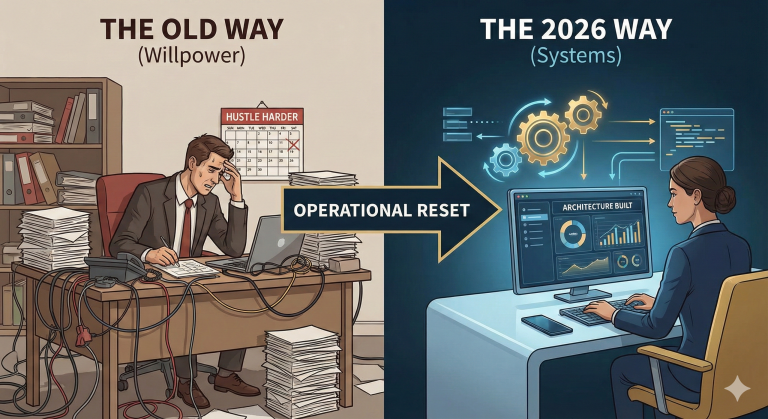

Most professional firms suffer from a self-inflicted wound: the “Complexity Trap.”
Leaders often believe that a sophisticated problem requires a sophisticated solution. They purchase enterprise-level software, hire consultants to build intricate diagrams, and end up with a system so fragile that one sick day or one manual entry error brings the entire operation to a halt.
Real operational strategy is about subtraction, not addition. If a process cannot be explained in three steps, it is likely broken.
The Cost of Friction
Friction is the silent killer of profitability in financial services. Every manual data re-entry, every “checking in” email, and every redundant approval layer acts as a tax on your team’s capacity.
- Fragmented Data: When your CRM doesn’t talk to your reporting tools, you aren’t running a business; you’re running a data entry farm.
- Shadow Processes: These are the “Excel trackers” employees keep on their desktops because they don’t trust the official system.
- Decision Fatigue: If your senior leaders are approving routine expenses or basic workflows, they are not leading. They are bottlenecks.
Automation Without the Fluff
Automation is not a magic wand. It is a logic multiplier. If your underlying process is chaotic, automation only serves to make you fail faster.
The goal for any professional organization should be “Durable Systems.” A durable system is one that functions independently of the person who built it. It relies on triggers and actions, not memory and effort.
- Standardize Before You Automate: Document the “happy path” of a task. Remove any step that doesn’t add value or meet a compliance requirement.
- Integrate the Core: Use tools like Power Automate or n8n to bridge the gap between your primary platforms.
- Audit for Reality: Check your dashboards. If the data there doesn’t match the reality of your bank account or your client list, your system is a lie.
Execution Over Theory
Theory looks good in a slide deck. Execution looks good on a P&L statement. In the Tampa market and beyond, the firms that scale are those that value “boring” consistency over “innovative” chaos.
Build systems that work when you are on vacation. Build workflows that a new hire can understand in an hour. Stop looking for the next big tech trend and start fixing the broken links in your current chain.
Operations is not about being fancy. It is about being effective.