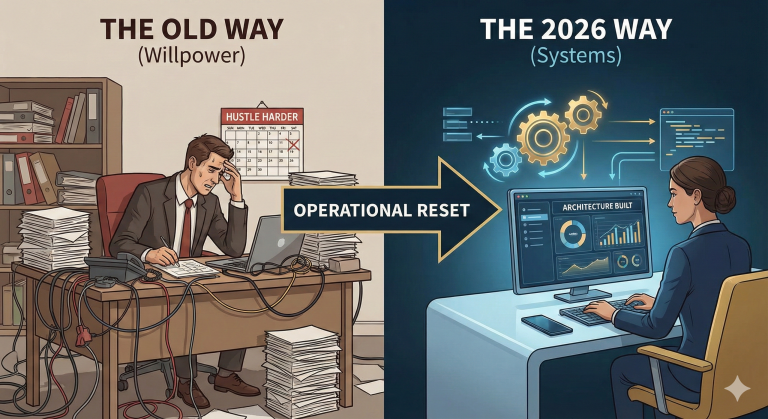
For the last two years, we have been stuck in the “Chatbot Era.” You asked a question, the AI gave you an answer, and then you—the human—had to go do the actual work. It was helpful, but it was passive.
Welcome to 2026. The passive era is over. We are now entering the age of Agentic AI, and for operational leaders in financial services, this is the most significant shift since the spreadsheet.
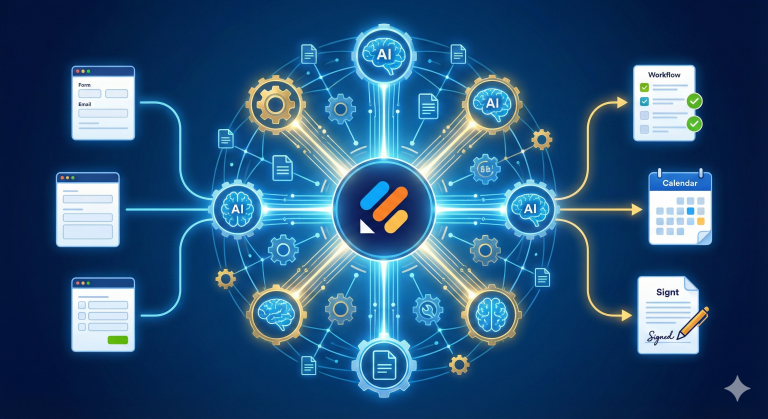
The difference is simple: A chatbot tells you how to update a client record. An AI Agent logs into the CRM, updates the record, sends the confirmation email, and schedules the follow-up task. If you are still looking at AI as a research assistant, you are already behind. Here is what the “Silent Workforce” looks like this year and how to deploy it without breaking your business.
From “Chat” to “Action”
The buzzword you will hear in every boardroom this quarter is “Multi-Agent Systems” (MAS). This isn’t science fiction; it is software.
In a traditional setup, a Client Service Associate (CSA) spends 30% of their day on low-value tasks: data entry, meeting prep, and compliance logging. In an Agentic model, you deploy specialized “digital employees” to handle these lanes:
- The Scheduler: Negotiates time slots with clients and updates Outlook.
- The Scribe: Listens to the Zoom call, drafts the summary letter, and files it in the document vault.
- The Watchdog: Scans transactions for anomalies and flags them for human review.
These agents don’t get tired, they don’t make transcription errors, and they don’t ask for PTO.
The “Garbage at Speed” Problem
Here is the cold water. You cannot hire AI agents if your operational house is dirty.
In 2025, many firms learned this the hard way. They plugged powerful AI tools into messy, fragmented data systems. The result wasn’t efficiency; it was chaos at the speed of light. If your current process for onboarding a client involves three different spreadsheets and a “mental checklist,” an AI agent will fail.
Agentic AI requires structured data and defined workflows. Before you subscribe to the next big tool, you must audit your “Process Truth.” If it isn’t documented, it can’t be automated.
The New Role of Humans: “Human-in-the-Loop”
Does this replace your team? No. It elevates them.
The most valuable asset in a professional firm is judgment. AI Agents are terrible at nuance, empathy, and complex negotiation. They are excellent at execution.
The winning org structure for 2026 is the “Human-in-the-Loop” model. Your human talent shifts from “doing the work” to “managing the agents.” They become the architects and the auditors, ensuring the output meets the firm’s standard while the agents handle the volume.
The Bottom Line
The firms that win in 2026 won’t be the ones with the flashiest marketing. They will be the ones that successfully outsource their “boring” work to software.
Stop hiring humans to do robot work. Clean your data, define your processes, and let the agents handle the rest.